 EN
EN

Citronella oil is one of the most widely produced essential oils in the world and serves as an important raw material for the fragrance, cosmetic, pharmaceutical, and specialty chemical industries. Among its various components, citronellal is the most valuable compound due to its characteristic lemon-like aroma and its role as a key intermediate in menthol production.
To maximize product value, many manufacturers perform citronellal extraction and citronellal purification after essential oil production. Among the available technologies, vacuum fractional distillation has become one of the most effective methods for separating citronellal from crude citronella oil while preserving product quality.
This article discusses the composition of citronella oil, the market value of citronellal, the recommended citronella oil distillation process, vacuum selection, and packed column design considerations for efficient separation.
Before designing a separation process, it is important to understand the chemical composition of citronella oil.
Citronella oil is mainly extracted from Cymbopogon winterianus and Cymbopogon nardus through steam distillation. The oil contains a complex mixture of terpene alcohols, aldehydes, and hydrocarbons.
Typical composition of citronella oil:
| Component | Typical Content (%) |
|---|---|
| Citronellal | 30–45 |
| Geraniol | 15–25 |
| Citronellol | 10–20 |
| Limonene | 1–5 |
| Geranyl Acetate | 2–8 |
| Other Terpenes | Balance |
Among these compounds, citronellal generally represents the highest-value fraction.
The challenge is that citronellal is mixed with compounds having similar boiling characteristics, making simple distillation insufficient for achieving high purity. Therefore, vacuum fractional distillation combined with an efficient packed column is often required.
Citronellal is widely used in multiple industries due to its fresh citrus aroma and chemical versatility.
Citronellal is a key ingredient in:
Natural citronellal is one of the most recognized active ingredients in plant-based insect repellents.
One of the largest industrial applications of citronellal is its conversion into menthol, which is widely used in pharmaceuticals, oral care products, and food additives.
Citronellal serves as an intermediate for the production of:
Because purified citronellal commands a significantly higher market price than crude citronella oil, investing in citronellal purification equipment can substantially improve profitability for essential oil producers.
Traditional atmospheric distillation often requires high temperatures, which can cause:
This is why vacuum fractional distillation is widely adopted in the essential oil industry.
Reducing system pressure lowers boiling points, allowing separation at gentler temperatures.
Vacuum conditions help preserve the natural aroma profile and chemical stability of citronellal.
A packed fractionation column improves theoretical separation stages, resulting in more efficient citronellal extraction.
Sensitive compounds remain protected throughout the distillation process.
A typical citronella oil distillation process consists of several stages.
Crude citronella oil is filtered to remove suspended solids and impurities.
The distillation system is evacuated to the desired operating pressure.
Low-boiling compounds such as limonene and lighter terpenes are removed first.
The operating temperature and reflux ratio are adjusted to collect the fraction rich in citronellal.
Heavier compounds such as citronellol and geraniol are separated in later fractions.
Depending on purity requirements, the citronellal-rich fraction may undergo a second-stage vacuum fractional distillation process.
This route is commonly used in pilot-scale and industrial fractional distillation equipment for essential oil processing.
Vacuum selection is one of the most critical factors affecting separation efficiency.
The ideal vacuum level depends on:
Typical operating vacuum ranges include:
| Vacuum Level | Application |
| -0.085 MPa | Basic separation |
| -0.090 MPa | Improved fractionation |
| -0.095 MPa | High-purity citronellal production |
| -0.098 MPa | Premium purification requirements |
However, excessively high vacuum may increase equipment costs and process complexity. Pilot testing is recommended to determine the optimal operating conditions.
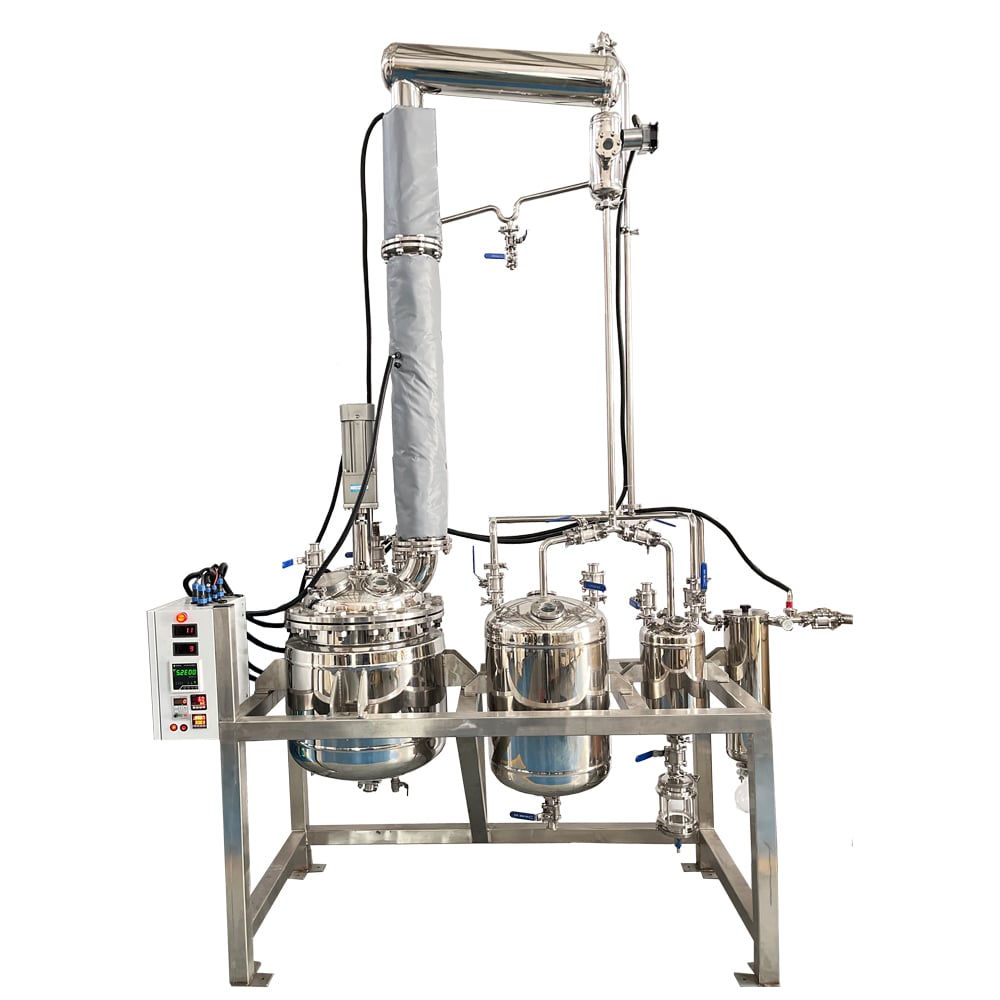
The fractionation column is the core component of any vacuum fractional distillation system.
The design of the packed column directly determines separation efficiency and final product purity.
Typical packed column heights include:
| Production Scale | Column Height |
| Laboratory | 1 m |
| Pilot Scale | 1.5–2 m |
| Industrial Scale | 2–4 m |
Higher purity requirements generally require taller columns.
Column diameter depends on:
Proper sizing helps prevent flooding and ensures stable operation.
Common packing options include:
Advantages:
Advantages:
Advantages:
For high-purity citronellal purification, stainless steel structured packing is often the preferred choice.
A complete fractional distillation equipment system for citronella oil processing usually includes:
As demand for natural fragrance ingredients continues to grow, efficient citronellal extraction has become increasingly important for essential oil manufacturers. Through properly designed vacuum fractional distillation systems, producers can achieve reliable citronellal purification while preserving product quality and maximizing profitability.
Successful citronella oil distillation depends on several key factors, including feed composition, vacuum level selection, reflux control, and packed column design. By choosing suitable fractional distillation equipment, manufacturers can efficiently separate citronellal from crude citronella oil and produce high-value products for fragrance, pharmaceutical, and specialty chemical markets.
Whether for pilot-scale development or industrial production, vacuum distillation remains one of the most practical and proven technologies for citronellal recovery and purification.
