 EN
EN

Eugenol is one of the most valuable natural compounds found in clove oil. Widely used in flavors, fragrances, pharmaceuticals, cosmetics, and dental products, high-purity eugenol is in constant demand across multiple industries. However, crude clove oil contains a mixture of compounds that must be separated to obtain concentrated eugenol.
Among the available purification methods, vacuum fractional distillation is one of the most effective and economical technologies for industrial-scale eugenol extraction and clove oil purification. By operating under reduced pressure, valuable components can be separated at lower temperatures, helping preserve product quality and minimize thermal degradation.
In this article, we will explore the process of vacuum distillation of clove oil, the principles behind eugenol separation, and the key considerations when selecting suitable fractional distillation equipment.
Eugenol (C₁₀H₁₂O₂) is a naturally occurring phenolic compound primarily obtained from clove buds, clove leaves, and clove stems.
Typical applications include:
Depending on the source, crude clove oil may contain 70–90% eugenol, along with other compounds such as:
To achieve higher purity levels required for industrial applications, further purification is necessary.
Traditional atmospheric distillation exposes essential oils to high temperatures, which may lead to:
This is why vacuum fractional distillation is commonly employed for clove oil purification.
Reducing system pressure lowers the boiling points of components, allowing separation at significantly lower temperatures.
Lower temperatures help preserve the chemical integrity of eugenol and maintain product color and odor characteristics.
Using a packed fractionation column increases the number of theoretical plates, resulting in more precise eugenol separation.
Vacuum conditions minimize exposure to oxygen, reducing oxidation and side reactions.
The objective of eugenol extraction through fractional distillation is to separate eugenol from other volatile and less volatile compounds present in crude clove oil.
The process relies on differences in vapor pressure and boiling behavior under vacuum conditions.
A properly designed packed column allows repeated vapor-liquid equilibrium cycles, improving product purity.
A complete fractional distillation equipment system typically consists of the following components:
Functions as the boiling vessel for crude clove oil.
Features:
The heart of the separation process.
Common configurations:
The column height is selected according to desired purity requirements.
Efficiently condenses vapors into liquid fractions.
Options include:
Maintains stable operating pressure throughout the process.
Common choices:
Separate collection vessels allow different fractions to be collected individually.
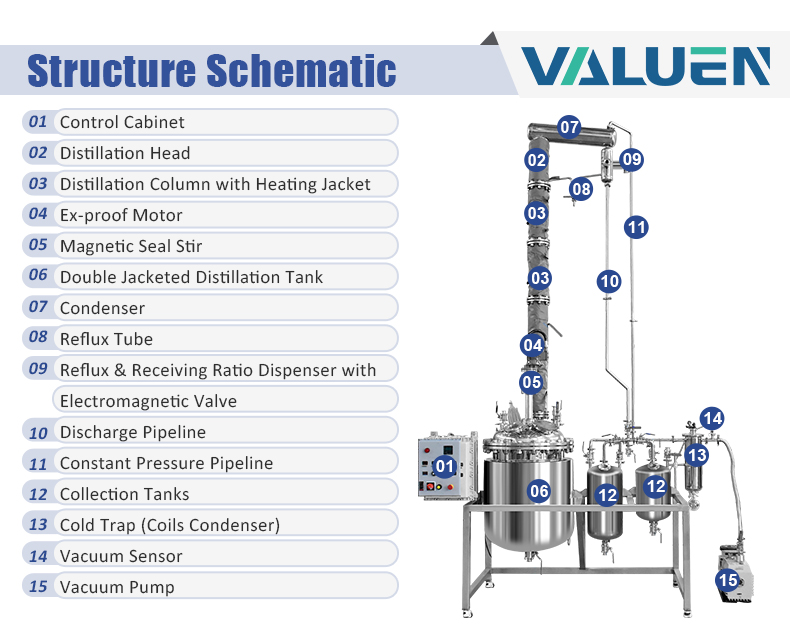
Actual operating conditions depend on feed composition, desired purity, equipment design, and production scale.
Typical operating ranges include:
| Parameter | Typical Range |
|---|---|
| Vacuum Level | -0.085 to -0.098 MPa |
| Kettle Temperature | 80–180°C |
| Column Type | Packed Fractionation Column |
| Column Height | 1–3 m |
| Material | SS304 / SS316L |
Process optimization should be determined through pilot-scale testing.
For manufacturers seeking commercial eugenol extraction, several system capacities are commonly used:
Suitable for:
Suitable for:
Suitable for continuous commercial production of purified eugenol.
Both glass and stainless steel systems are used in essential oil processing.
Advantages:
Limitations:
Advantages:
For medium and large-scale vacuum distillation of clove oil, stainless steel equipment is generally preferred.
After successful eugenol separation, the purified product can be used in:
The market value of high-purity eugenol is significantly higher than that of crude clove oil, making purification an attractive investment for essential oil producers.
As global demand for natural ingredients continues to grow, efficient eugenol extraction has become increasingly important for essential oil processors and chemical manufacturers.
Compared with conventional distillation methods, vacuum fractional distillation offers superior product quality, higher separation efficiency, and better protection of heat-sensitive compounds. By utilizing properly designed fractional distillation equipment, manufacturers can achieve reliable clove oil purification and produce high-purity eugenol suitable for high-value applications.
Whether for laboratory research, pilot production, or industrial manufacturing, a well-engineered vacuum distillation system can provide an effective solution for the purification of clove oil and the separation of valuable natural compounds.
