 EN
EN

Patchouli oil is one of the most important natural essential oils used in the fragrance, cosmetics, aromatherapy, and personal care industries. Known for its rich, earthy, woody aroma, patchouli oil is widely utilized as a base note in perfumes and as a valuable ingredient in high-end fragrance formulations.
The primary active component responsible for the characteristic scent and commercial value of patchouli oil is patchoulol. As market demand for high-purity natural ingredients continues to increase, manufacturers are increasingly investing in advanced patchouli oil purification technologies to improve product quality and maximize profitability.
Among the available separation technologies, a stainless steel fractional distillation system offers an efficient and scalable solution for patchoulol extraction and patchouli oil refining.
This article explores the composition of patchouli oil, purification strategies, distillation column design, and vacuum system selection for efficient patchoulol recovery.
Patchouli oil is typically obtained through steam distillation of the leaves of Pogostemon cablin.
The oil contains a complex mixture of sesquiterpenes and oxygenated compounds that contribute to its unique aroma profile.
Typical composition of patchouli oil includes:
| Component | Typical Content (%) |
|---|---|
| Patchoulol | 25–40 |
| α-Bulnesene | 10–20 |
| α-Guaiene | 10–18 |
| Seychellene | 3–8 |
| Pogostol | 1–5 |
| Other Sesquiterpenes | Balance |
Among these compounds, patchoulol is considered the most valuable component due to its superior fragrance characteristics and market demand.
Because patchoulol coexists with many compounds having similar boiling behaviors, efficient patchouli oil purification requires carefully designed fractional distillation equipment.
Patchoulol is widely used in:
Compared with crude patchouli oil, high-purity patchoulol commands significantly higher market value.
Therefore, successful patchoulol extraction can substantially increase the profitability of patchouli oil processing operations.
Unlike light essential oils such as citronella oil or eucalyptus oil, patchouli oil contains heavier sesquiterpene compounds with relatively high boiling points.
Key challenges include:
To overcome these challenges, manufacturers often employ vacuum fractional distillation using stainless steel systems.
Operating under vacuum allows separation at lower temperatures, helping preserve aroma quality while improving product purity.
A typical patchouli oil refining process includes several stages.
Crude patchouli oil is filtered to remove impurities and suspended particles.
The distillation system is evacuated to the target operating pressure.
The oil is heated gradually in a jacketed stainless steel reactor.
Vapors enter the packed distillation column, where repeated vapor-liquid equilibrium improves separation efficiency.
The fraction enriched in patchoulol is collected separately.
Depending on purity requirements, a second distillation stage may be performed to further enhance patchoulol concentration.
This process is widely used for industrial-scale patchouli oil purification.
The fractionation column is the most important component of the distillation system.
Proper column design directly affects:
Typical column heights include:
| Production Scale | Column Height |
| Laboratory | 1 m |
| Pilot Scale | 1.5–2 m |
| Industrial Scale | 2–4 m |
Higher purity requirements generally require taller columns.
Common packing options include:
Advantages:
Advantages:
Advantages:
For high-purity patchoulol extraction, structured packing is typically preferred.
Accurate reflux control significantly improves separation performance and final patchoulol purity.
Modern systems often utilize automated reflux control through PLC systems.
Selecting the proper vacuum system is critical for successful patchouli oil refining.
Operating under vacuum provides several benefits:
| Vacuum Level | Application |
| -0.085 MPa | Standard purification |
| -0.090 MPa | Improved fractionation |
| -0.095 MPa | High-purity patchoulol production |
| -0.098 MPa | Premium-grade purification |
Advantages:
Advantages:
Advantages:
The optimal vacuum configuration depends on production capacity and target purity requirements.
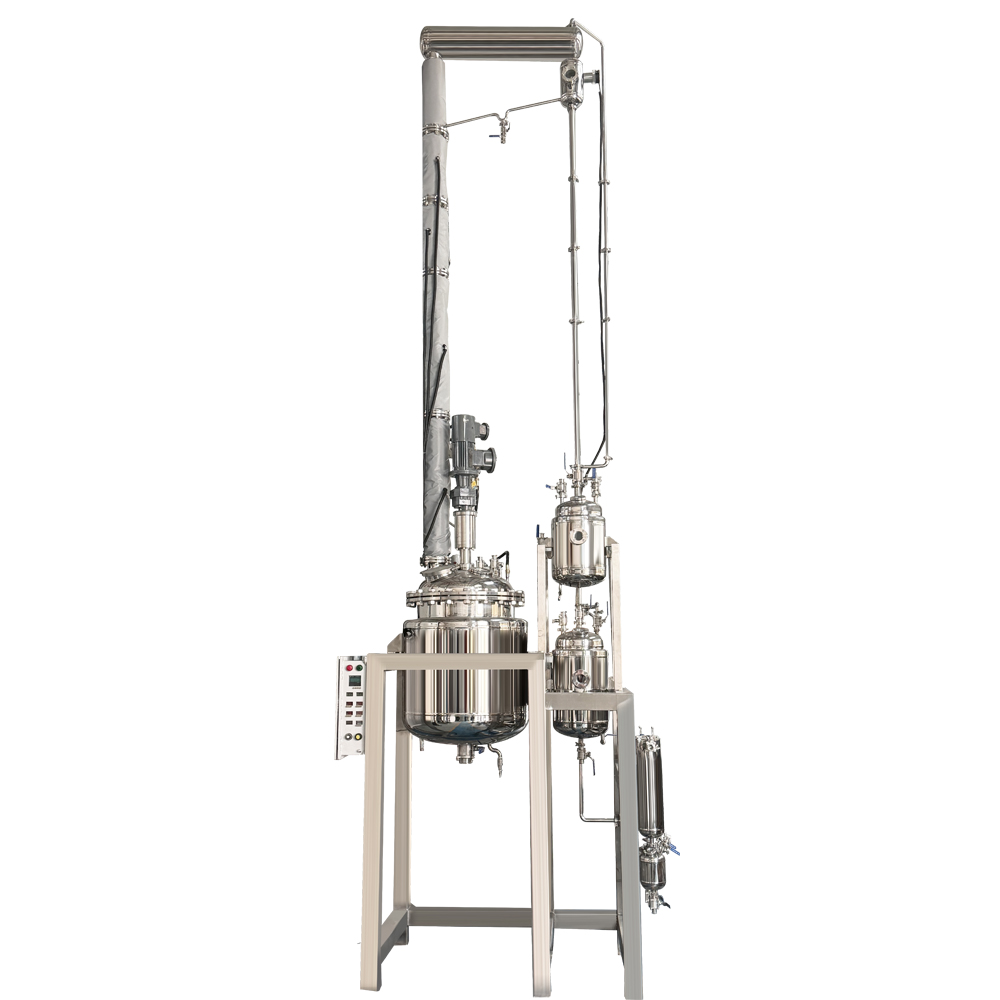
For commercial patchouli oil purification, stainless steel systems offer significant advantages over traditional glass equipment.
Stainless steel reactors and columns can withstand continuous industrial operation.
Metal systems typically achieve more stable vacuum conditions.
Production capacities can be expanded from pilot scale to industrial scale.
Suitable for long-duration operation and commercial manufacturing environments.
Stainless steel systems provide excellent resistance to corrosion and wear.
A complete system for patchouli oil refining generally includes:
Common capacities include:
These systems can be customized according to production requirements and target purity specifications.
As demand for premium natural fragrance ingredients continues to grow, efficient patchouli oil purification has become increasingly important for essential oil manufacturers.
By utilizing a well-designed stainless steel fractional distillation system, producers can achieve reliable patchoulol extraction, improve product quality, and increase the value of their patchouli oil products.
Successful patchouli oil refining depends on several key factors, including feed quality, distillation column design, reflux control, and vacuum system selection. With the right equipment and process optimization, manufacturers can consistently produce high-purity patchoulol for the fragrance, cosmetic, and specialty chemical industries.
