 EN
EN

Cinnamon oil is one of the most valuable natural essential oils on the market. Its primary active compound, cinnamaldehyde, accounts for 70–88% of the oil's composition and is responsible for its characteristic flavor, aroma, and numerous health benefits—including antibacterial, antifungal, and antioxidant properties . However, the market increasingly demands higher purity cinnamaldehyde for pharmaceutical, food, and cosmetic applications. This is where advanced fractional distillation equipment becomes essential.
For producers looking to refine cinnamon oil and achieve cinnamaldehyde purity of 99% or higher, choosing the right distillation system is critical. In this article, we explore the cinnamon oil refining process, the role of stainless steel fractional distillation equipment, and how to optimize operations to maximize both purity and yield.
Crude cinnamon oil contains a complex mixture of compounds. Beyond cinnamaldehyde, it includes benzaldehyde, coumarin, salicylaldehyde, cinnamyl acetate, and others . Each of these components has commercial value, but isolating them requires precise separation.
Refined cinnamaldehyde commands premium pricing, particularly when purity exceeds 98%. Studies demonstrate that achieving cinnamaldehyde purity of 99 wt% with recovery rates above 86% is feasible through batch vacuum rectification . The global cinnamon market continues to grow, with China leading exports at over USD 474 million annually—representing a 20.5% market share . This presents a significant opportunity for producers equipped with modern cinnamon oil distillation capabilities.
Fractional distillation is the preferred method for cinnamon oil purification because it separates components based on their boiling points. However, cinnamon oil contains heat-sensitive compounds that degrade at high temperatures. This is why vacuum fractional distillation is essential—operating under reduced pressure lowers boiling points, preserving product quality .
Research on batch rectification columns for cinnamon essential oil has identified optimal separation conditions:
Benzaldehyde (99% purity): 124°C at 0.2 atm
Trans-cinnamaldehyde (99% purity): 190.5°C under vacuum
These precise temperature and pressure parameters demonstrate why fractional distillation equipment with accurate control systems is indispensable.
Batch distillation offers unique advantages for essential oil fractionation:
Flexibility to separate multiple product segments using a single column
Adjustable operating parameters for varying feed compositions
Widely used for small-scale production of perfumes, pharmaceuticals, and chemical products
However, batch processes have longer retention times, which can cause thermal degradation. Operating under vacuum mitigates this risk. Packed distillation columns are preferred over tray columns because they reduce pressure loss, further lowering boiling temperatures and protecting heat-sensitive compounds .
Achieving high-purity cinnamaldehyde requires careful attention to several process parameters:
The separation temperature for high-purity cinnamaldehyde (99 wt%) is approximately 190.5°C under vacuum . Vacuum operation is non-negotiable—it prevents thermal degradation while enabling effective separation from lighter components like benzaldehyde and heavier compounds like methoxy cinnamaldehyde.
Reflux ratio significantly impacts separation efficiency. For batch distillation of cinnamon oil, a reflux ratio of 2:1 has been shown effective in vacuum distillation processes, achieving product purity of 98.66% and yield of 84.68% . Higher reflux ratios improve purity but reduce production rates—finding the optimal balance is key.
The number of theoretical plates in the distillation column determines separation capability. Studies on similar essential oil systems recommend:
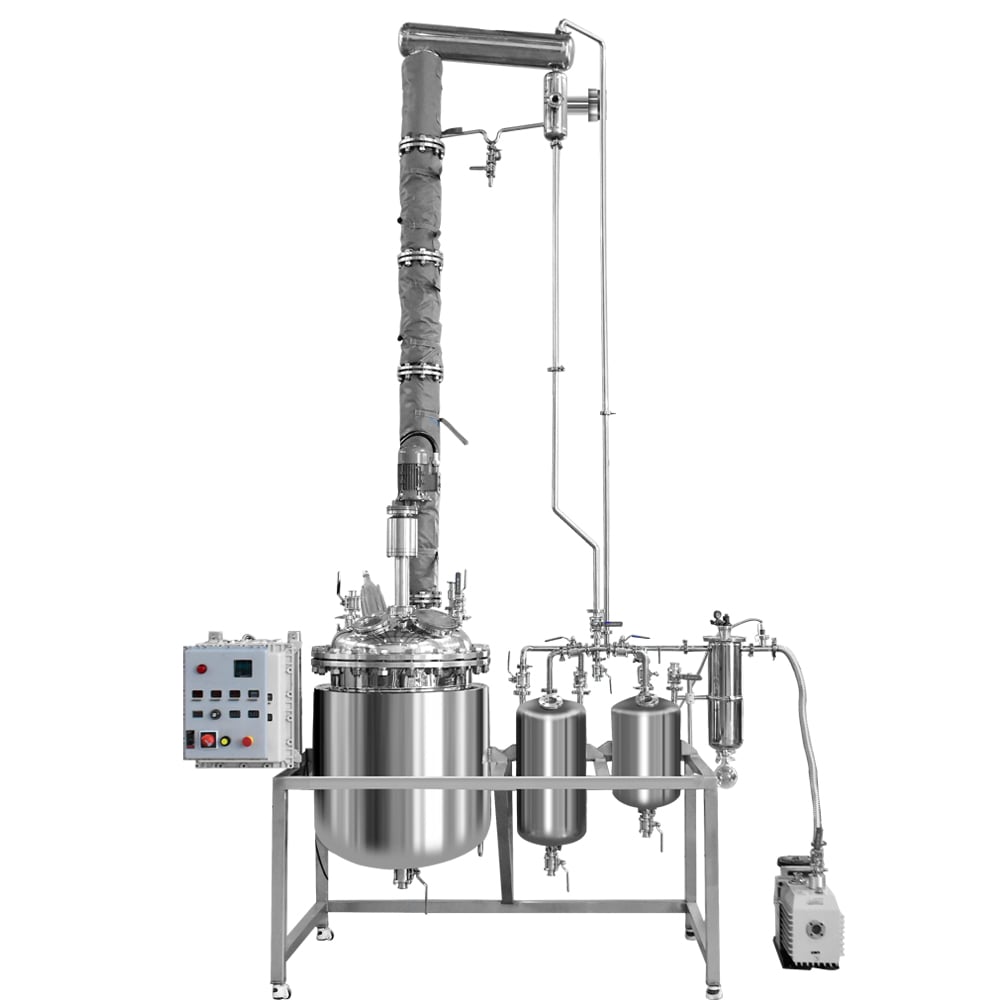
Packed columns with stainless steel or glass packing materials can be configured to achieve the required theoretical plates. Our stainless steel fractional distillation equipment can be assembled with column heights of 1m, 1.5m, or 2m, allowing customization for different separation requirements .
Cinnamaldehyde content in crude cinnamon oil typically ranges from 70–88% . Feed composition influences separation efficiency. Pre-treatment steps, such as steam distillation or molecular distillation, can increase feed concentration before fractionation, improving overall efficiency .
When selecting cinnamon oil distillation equipment, consider these critical features:
Stainless steel offers superior corrosion resistance, durability, and cleanliness—essential for essential oil production where product purity is paramount. Our equipment is specifically designed for the rigorous demands of essential oil fractionation.
The ability to adjust column height and packing materials allows processors to tailor equipment to specific separation challenges. Whether you need to separate cinnamaldehyde from lighter aldehydes or heavier compounds, flexible column configuration ensures optimal performance .
Vacuum operation is essential for heat-sensitive oils. Our systems are engineered for stable vacuum performance, enabling precise temperature control and protecting product quality.
From laboratory-scale 10L units to industrial-scale batch sizes of 1000 kg or more, stainless steel fractional distillation equipment can be scaled to meet production demands .
Recent research validated a batch rectification column model for cinnamon oil fractionation. Key findings include:
Four product segments were successfully fractionated from a single batch
Trans-cinnamaldehyde purity reached 96.31 wt% in experimental runs
Process modeling identified conditions to achieve 99 wt% purity with 86% recovery for cinnamaldehyde
The model was successfully scaled to 1000 kg/batch operations
These results confirm that commercial-scale cinnamaldehyde extraction is achievable with properly designed fractional distillation systems.
The demand for high-purity cinnamaldehyde continues to grow across pharmaceutical, food, and cosmetic industries. Producers equipped with advanced fractional distillation equipment can meet this demand by operating under optimal conditions—vacuum, precise temperature control, appropriate reflux ratios, and flexible column configurations.
Our stainless steel fractional distillation equipment is engineered specifically for essential oil applications, including cinnamon oil purification. With customizable column heights, high-quality packing materials, and reliable vacuum performance, our systems help producers achieve cinnamaldehyde purity of 99% or higher while maximizing yield.
Contact us today to discuss your cinnamon oil refining requirements and learn how our fractional distillation equipment can help you achieve superior product quality.
