 EN
EN

Choosing the right agitator for your stainless steel jacketed reactor is one of the most critical engineering decisions you will make. The agitator is the heart of the mixing process—it determines reaction efficiency, product quality, and energy costs. A poorly matched agitator can lead to dead zones, inconsistent temperature control, and failed batches. A properly selected one ensures optimal mass transfer, uniform heating or cooling, and reliable scale-up from lab to production.
This guide walks you through a systematic approach to agitator selection, matching impeller types to specific process objectives and fluid properties.
Before diving into impeller types, you need to assess three fundamental aspects of your application: your process objective, your fluid properties, and the required flow pattern.
What are you trying to accomplish with agitation? Different objectives demand different fluid motion characteristics:
Liquid-Liquid Blending: Creating a uniform mixture of miscible liquids requires bulk turnover and efficient axial flow.
Solid Suspension: Keeping solid particles suspended requires strong vertical flow currents to prevent settling.
Gas Dispersion: Breaking gas into fine bubbles for reactions like hydrogenation requires high local shear.
Heat Transfer Enhancement: Moving fluid past the jacket or internal coils requires flow patterns that sweep vessel walls.
Emulsification: Creating stable emulsions requires controlled shear to achieve target droplet sizes.
Each objective points to a different impeller geometry.
Fluid properties—especially viscosity—are the single largest factor determining which impeller style will be effective.
Low to Medium Viscosity (< 50,000 cP): These fluids behave like water or light oils. Standard turbine or hydrofoil impellers work effectively in the turbulent regime. Baffles are essential to prevent vortexing and ensure proper mixing.
High Viscosity ( 50,000 cP): Thick pastes, polymers, and heavy slurries behave differently. Open turbine impellers simply carve a hole in the fluid without moving the bulk. These applications require close-clearance impellers like anchors or helical ribbons that physically sweep the vessel wall and operate in the laminar regime.
For non-Newtonian fluids—those whose viscosity changes with shear rate—the selection becomes more complex. These fluids require careful consideration of rheological behavior, often needing close-clearance designs to maintain consistent motion throughout the vessel.
Impellers generate one of two primary flow patterns:
Axial Flow: Fluid is pushed downward toward the bottom of the tank, then flows up the vessel walls. This creates excellent top-to-bottom turnover, ideal for blending and solid suspension. Hydrofoil and pitched-blade turbines generate axial flow.
Radial Flow: Fluid is discharged outward toward the vessel walls, creating high shear near the impeller. This is ideal for gas dispersion and emulsification. Rushton turbines generate radial flow.
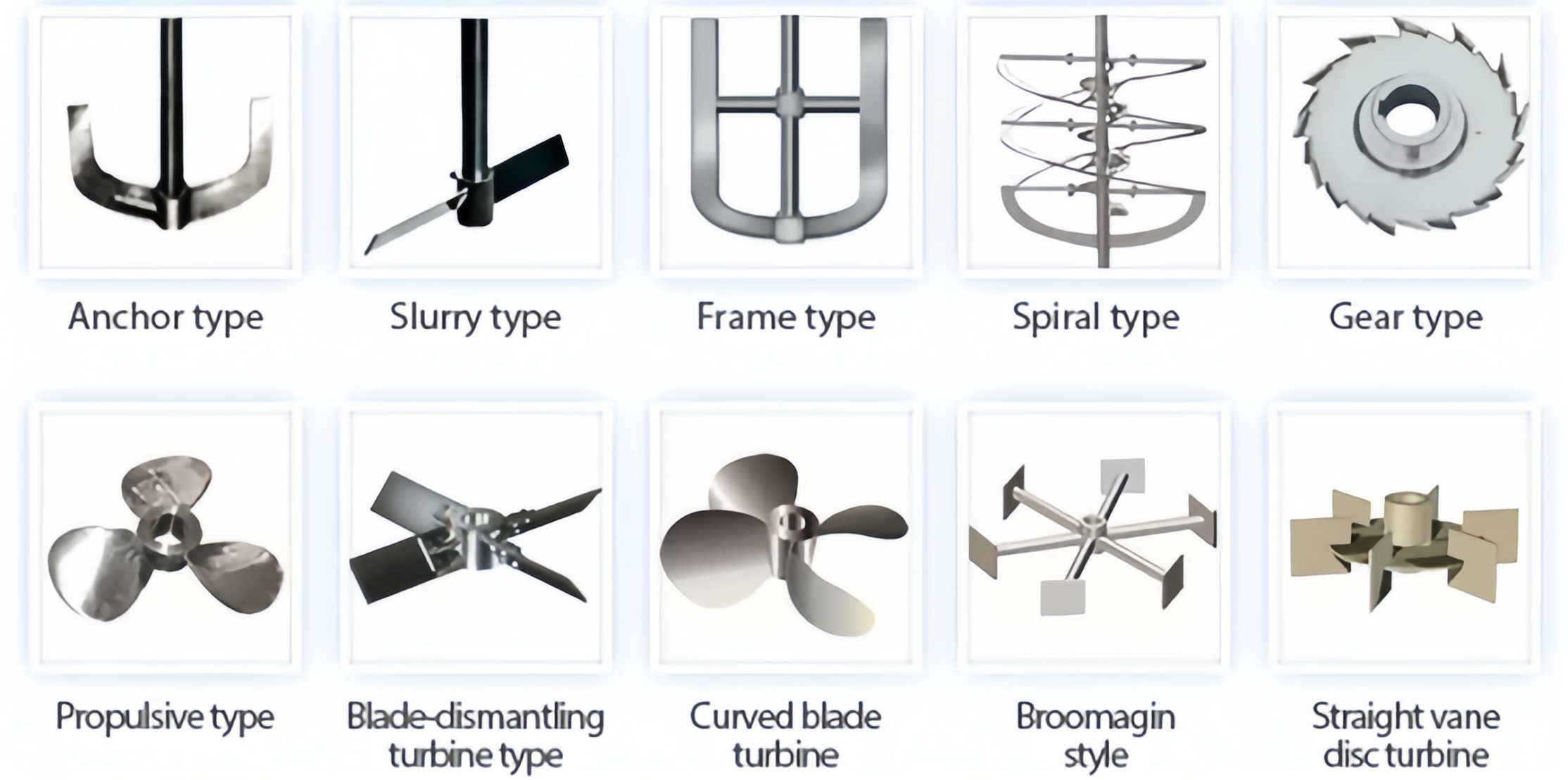
Hydrofoil Impellers: These are the modern standard for efficient liquid blending. Their curved, profiled blades generate strong axial flow with very low power consumption (power number as low as 0.30), making them the most energy-efficient choice for simple mixing and blending operations.
Pitched-Blade Turbines (PBT): A versatile workhorse. The flat blades are angled at approximately 45° to produce strong axial flow with some radial component, with a power number around 1.30. They excel at solid suspension and general-purpose mixing. For high-viscosity applications at the lower end of the range, a slower PBT may be suitable.
Rushton Turbines: The classic high-shear, radial-flow impeller. With a power number of approximately 5.00, it consumes significantly more energy than axial-flow designs but is unmatched for gas dispersion, breaking gas into fine bubbles to maximize gas-liquid contact area.
Selection Trade-off: There is a direct trade-off between pumping efficiency and shear intensity. A hydrofoil maximizes flow with minimal power; a Rushton turbine maximizes shear at high energy cost. Choose the impeller with the lowest power number that still achieves your required process outcome to reduce both capital and operating costs.
Anchor Impellers: A simple two-bladed design that sweeps close to the vessel wall, improving mixing and enhancing heat transfer at the jacket surface. Best suited for moderate-to-high viscosity applications where some top-to-bottom mixing is still possible.
Helical Ribbon Impellers: The superior choice for very high viscosities. The outer ribbon scrapes the wall and lifts fluid upward, while an inner ribbon or screw pushes fluid down the center. This creates positive, predictable turnover in materials that would otherwise not flow. Essential for applications like polymer processing or thick pastes.
Sizing Note: For high-viscosity systems above 25,000 cP, close-clearance impellers operating in the laminar regime are required to ensure bulk movement. Standard centrifugal pumps typically handle a maximum viscosity of 800 cP, beyond which specialized high-viscosity impellers become necessary.
Different reaction types have specific agitation requirements:
| Reaction Type | Recommended Impeller | Justification |
|---|---|---|
| Liquid blending, dissolution | Hydrofoil | Efficient axial flow, low power consumption |
| Solid suspension, slurry | Pitched-Blade Turbine | Strong axial flow prevents settling |
| Gas-liquid reactions (hydrogenation, oxidation) | Rushton Turbine | High shear for fine bubble dispersion |
| High-viscosity polymerization | Helical Ribbon | Positive turnover in laminar regime |
| Temperature-sensitive reactions | Anchor with baffles | Sweeps wall for uniform heat transfer |
| Shear-sensitive biological cultures | Hydrofoil (low tip speed) | Avoids cell damage |
Proper agitator sizing involves key dimensionless parameters:
Impeller Reynolds Number: Determines flow regime
Re = (D² × N × ρ) / μ
Re < 10: Laminar flow
Re 10,000: Turbulent flow
Between: Transitional flow
Power Number: Remains constant in turbulent regime, used to calculate power draw
Impeller-to-Tank Diameter Ratio (D/T): Typically 0.33 for standard mixing
Power Requirement Rule of Thumb: Size the motor so that operating power does not exceed 85% of rated capacity. This 85% rule accounts for startup torque, viscosity increases during reactions, and safety margins for process upsets. Undersizing leads to overheating and failure; oversizing wastes capital and energy.
For low-viscosity applications, an unbaffled tank will create a vortex—the fluid simply rotates with the impeller, resulting in almost no actual mixing.
Baffles—vertical plates installed on the tank wall—are essential to break this rotation and convert swirling motion into the desired axial or radial flow. Standard industrial practice uses four baffles, each with a width of 1/12th to 1/10th of the tank diameter.
For high-viscosity applications with close-clearance impellers, baffles are typically not needed or used.
Your agitator must withstand the chemical environment. For stainless steel jacketed reactors, common material grades include:
304 Stainless Steel: Suitable for food, water treatment, and fine chemicals without strong corrosive agents
316L Stainless Steel: Contains molybdenum (2-3%), providing superior resistance to chlorides and halides. Recommended for pharmaceutical, biotech, and marine applications
Hastelloy C-276: For highly corrosive environments beyond stainless steel capability
Moving from lab-scale to production-scale is one of the most challenging aspects of agitator specification. You cannot maintain all dimensionless parameters simultaneously when vessel geometry increases.
Common scale-up strategies:
Constant power per unit volume (P/V): Preserves reaction kinetics but increases tip speed at larger diameters, potentially damaging shear-sensitive materials
Constant tip speed: Protects shear-sensitive materials but may reduce mass transfer capacity
Constant Reynolds number: Difficult to achieve across large scale changes
The best approach depends on your primary process objective. For mass transfer applications (gas dispersion), maintain constant P/V. For shear-controlled processes (cell cultures, crystal slurries), maintain constant tip speed.
Selecting the right agitator for your stainless steel jacketed reactor requires a systematic approach:
Define your process objective—what are you trying to accomplish?
Characterize your fluid—viscosity and rheology are the most critical factors
Match impeller type to application—axial flow for blending and suspension, radial flow for gas dispersion, close-clearance for high viscosity
Size properly—use dimensionless numbers and the 85% power rule
Consider scale-up—plan for the transition from lab to production
Specify compatible materials—match alloy to your chemical environment
A well-selected agitator does more than mix—it ensures consistent product quality, reduces energy consumption, and extends the life of your equipment. Take the time to get it right, and your stainless steel jacketed reactor will perform optimally for years to come.
