 EN
EN

When it comes to purifying essential oils, the choice of separation method directly determines the quality of the final product. Vacuum fractional distillation has emerged as the preferred technique among producers who demand both purity and yield without compromising the delicate aromatic compounds that define premium essential oils. Unlike conventional atmospheric distillation, vacuum fractional distillation operates under reduced pressure, which fundamentally changes how heat interacts with sensitive botanical materials.
The essential oil industry relies on separation techniques that can isolate specific chemical fractions while preserving the biological integrity of aromatic molecules. Vacuum fractional distillation achieves this by combining the precision of fractional column separation with the thermal advantages of a vacuum environment. This dual mechanism makes vacuum fractional distillation especially well-suited to the complex, heat-sensitive compositions found in lavender, rose, sandalwood, and other commercially significant essential oils. Understanding why vacuum fractional distillation outperforms other methods requires examining its core operating principles and the unique demands of essential oil chemistry.
The Science Behind Vacuum Fractional Distillation for Essential Oils
How Reduced Pressure Protects Aromatic Compounds
Essential oils contain terpenes, esters, aldehydes, and phenols that begin to degrade at relatively modest temperatures. Standard atmospheric distillation exposes these compounds to boiling points that frequently exceed their thermal stability thresholds. Vacuum fractional distillation solves this by lowering the system pressure, which in turn lowers the boiling points of all components within the mixture. As a result, vacuum fractional distillation can separate volatile fractions at temperatures often 30 to 60 degrees lower than atmospheric equivalents, dramatically reducing the risk of thermal decomposition.
This temperature reduction is not merely a technical detail. It is the reason that vacuum fractional distillation consistently produces essential oils with cleaner scent profiles, higher ester content, and fewer degradation byproducts. For producers supplying the fragrance, cosmetic, and therapeutic markets, these quality indicators directly influence product pricing and customer acceptance. Vacuum fractional distillation therefore offers a commercially meaningful advantage that goes beyond laboratory precision.
The Role of Fractional Column Separation
While the vacuum environment protects sensitive molecules, the fractional column component of vacuum fractional distillation enables the precise separation of individual chemical fractions. A standard simple distillation cannot distinguish between compounds whose boiling points lie within a narrow range. The packed or plated column used in vacuum fractional distillation creates multiple theoretical separation stages, allowing components with closely similar volatilities to be isolated in sequence. This is critical for essential oils, where the difference between a desirable terpene fraction and an unwanted impurity may be as little as a few degrees of boiling point difference. Vacuum fractional distillation makes those separations reliably achievable at production scale.
Specific Advantages of Vacuum Fractional Distillation in Essential Oil Processing
Yield Optimization Without Quality Sacrifice
One of the most commercially important benefits of vacuum fractional distillation is that it allows processors to recover a higher proportion of target fractions from raw essential oil feedstock. Because vacuum fractional distillation operates at lower temperatures, fewer desirable molecules are lost to thermal cracking or polymerization. Processors using vacuum fractional distillation report improved recovery rates for high-value terpene alcohols such as linalool and geraniol, compounds that are difficult to retain under atmospheric conditions. The result is a more efficient process where vacuum fractional distillation converts more of the raw material into saleable, high-quality output.
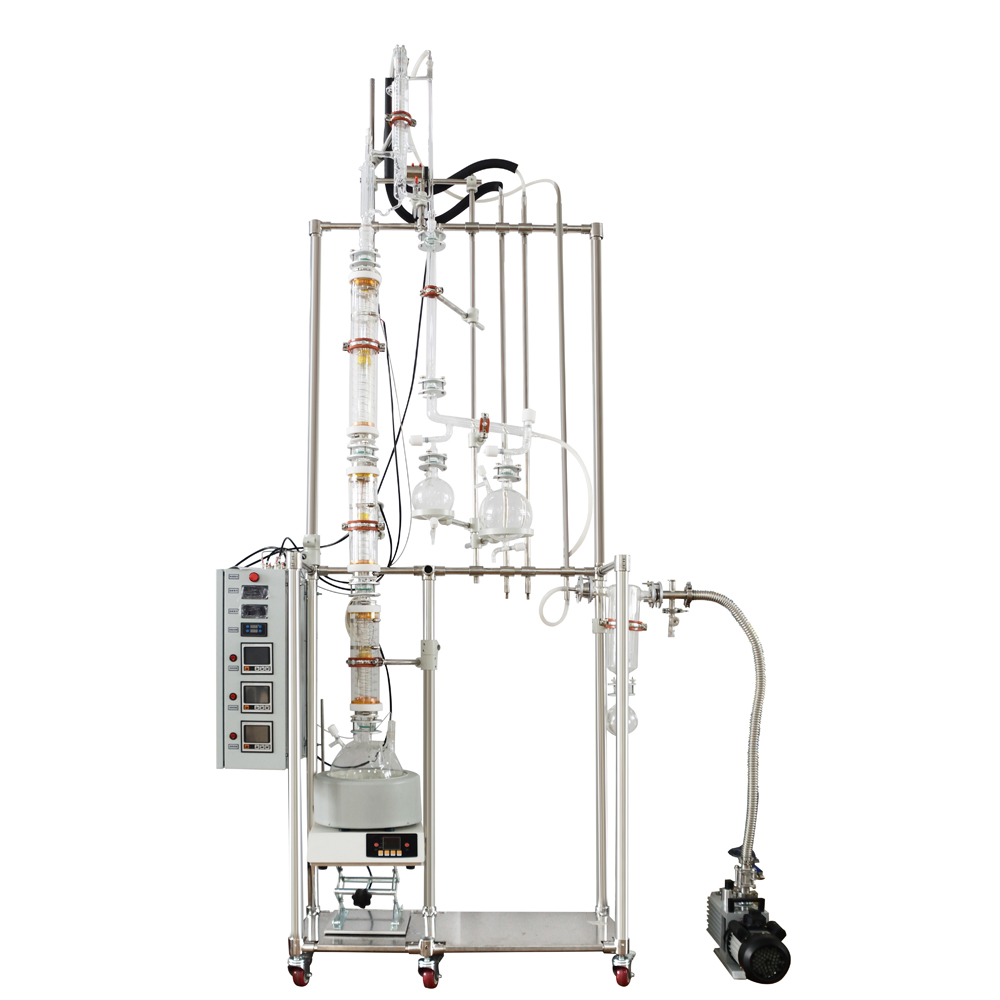
Beyond individual compound recovery, vacuum fractional distillation also enables batch processors to collect distinct fractions sequentially during a single run. Each fraction collected through vacuum fractional distillation can be evaluated, blended, or sold independently based on its chemical profile. This fraction-by-fraction control gives essential oil producers greater flexibility than any single-stage distillation method can provide, and it is one of the primary reasons that vacuum fractional distillation has become the standard approach in professional-grade essential oil refineries.
Scalability and Process Consistency
Vacuum fractional distillation is not limited to laboratory-scale applications. Industrial glass distillation systems designed for vacuum fractional distillation are available in capacities suitable for both pilot-scale research and full commercial production. The consistency of vacuum fractional distillation across batch sizes is an important consideration for producers who need to maintain specification compliance across multiple production runs. Because vacuum fractional distillation relies on controlled physical parameters rather than variable biological extraction conditions, operators can reproduce separation profiles reliably from one batch to the next. This reproducibility is a significant advantage over steam distillation and cold-press extraction in contexts where regulatory compliance and customer specifications demand tight compositional tolerances.
Selecting the Right Equipment for Vacuum Fractional Distillation
Key Equipment Features That Matter
Effective vacuum fractional distillation depends on equipment that maintains stable vacuum levels, supports precise temperature gradients across the column, and minimizes dead volume where product can accumulate and degrade. Glass distillation systems are widely preferred for essential oil vacuum fractional distillation because they allow visual monitoring of the separation process and resist chemical interaction with aromatic compounds. The column packing material used in vacuum fractional distillation also influences theoretical plate count, which directly determines separation efficiency. Processors should evaluate column height, packing density, and condenser design when specifying vacuum fractional distillation equipment for essential oil applications.
Operational Parameters to Control
Successful vacuum fractional distillation requires careful management of vacuum depth, heating rate, and reflux ratio. The reflux ratio in vacuum fractional distillation determines how much condensed vapor is returned to the column versus collected as product. A higher reflux ratio in vacuum fractional distillation produces sharper separations but reduces throughput, while a lower ratio increases throughput at the cost of fraction purity. Operators experienced with vacuum fractional distillation learn to balance these parameters based on the specific essential oil being processed and the purity requirements of the target fraction. Accurate vacuum gauging and temperature logging are essential tools for repeatable vacuum fractional distillation performance.
FAQ
What types of essential oils benefit most from vacuum fractional distillation?
Heat-sensitive oils such as rose, jasmine, neroli, and sandalwood benefit most from vacuum fractional distillation because their key aromatic compounds degrade quickly at atmospheric boiling temperatures. Vacuum fractional distillation preserves these compounds by reducing operating temperatures while still achieving precise fraction separation.
How does vacuum fractional distillation differ from steam distillation?
Steam distillation uses steam as a carrier to volatilize essential oil components, which limits separation precision and exposes compounds to moisture and heat simultaneously. Vacuum fractional distillation separates components based on volatility differences under controlled low-pressure conditions, offering finer fraction resolution and lower thermal exposure than steam distillation can provide.
Is vacuum fractional distillation suitable for small-scale essential oil producers?
Yes, vacuum fractional distillation equipment is available in bench-top and pilot-scale configurations that are practical for small and medium producers. Entry-level vacuum fractional distillation systems allow smaller operations to achieve professional-grade purity and fraction control without the capital investment associated with large industrial distillation infrastructure.