 EN
EN

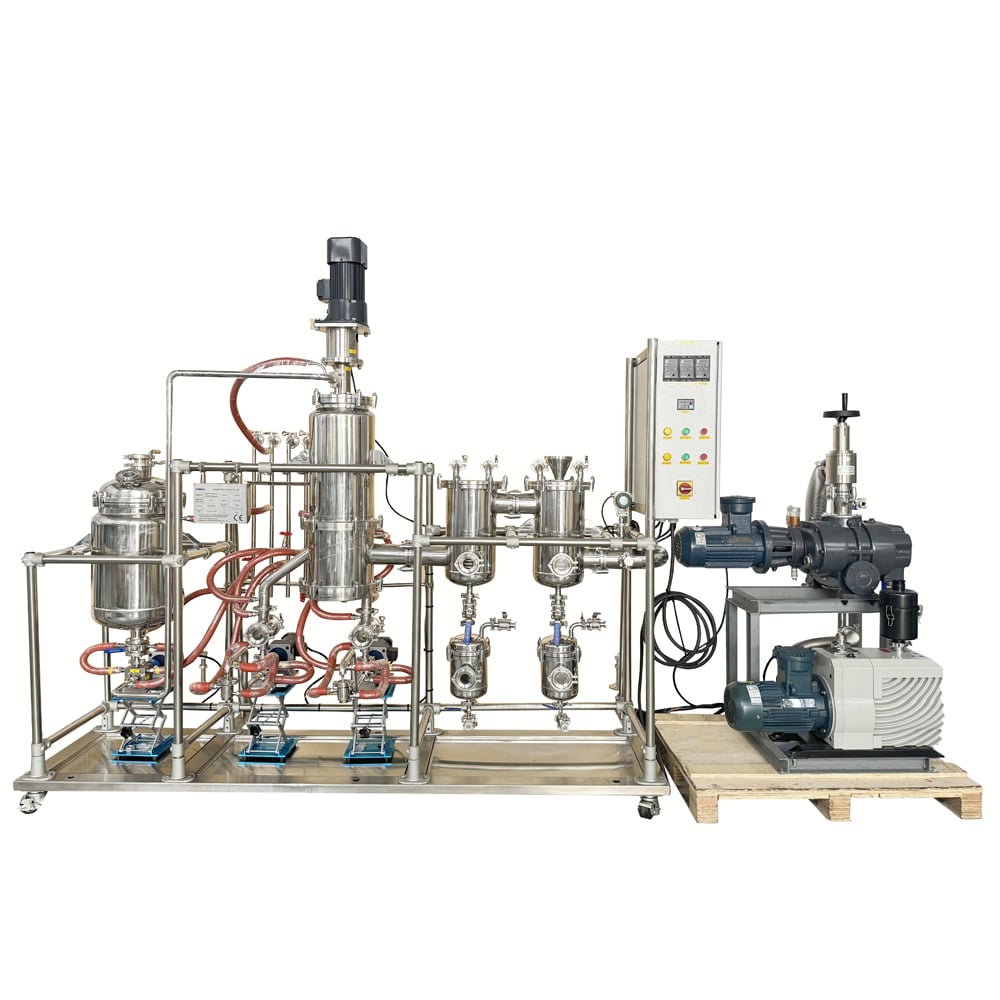
Selecting the right Wiped Film Evaporator (WFE) for essential oil processing is one of the most critical decisions a producer can make. The quality of your final extract, the efficiency of your thermal separation process, and your overall throughput all depend heavily on the evaporator technology you choose. Among the separation methods available today, the Wiped Film Evaporator stands out as the premier, highly effective solution for processing the heat-sensitive botanical compounds found in premium essential oils.
Understanding why the Wiped Film Evaporator is the industry standard for this application requires a closer look at how essential oil compounds behave under thermal stress. Terpenes, esters, and aromatic aldehydes degrade quickly when exposed to prolonged heat. The Wiped Film Evaporator directly addresses this challenge by minimizing residence time to seconds and operating under deep vacuum conditions, preserving volatile aromatic compounds that would otherwise be lost or damaged in conventional distillation setups. Choosing correctly means matching your product chemistry with the precise specifications of your Wiped Film Evaporator.
Core Selection Criteria for Your Wiped Film Evaporator
Understanding Thermal Sensitivity of Essential Oil Compounds
Essential oils contain a broad spectrum of volatile and semi-volatile compounds, many of which are extremely sensitive to heat. When evaluating a Wiped Film Evaporator, your first consideration must be how effectively it minimizes the thermal load placed on your product.
A high-performance Wiped Film Evaporator operates by spreading a thin, continuously refreshed film of liquid across a heated internal surface. This mechanical action dramatically reduces the time any single compound spends at an elevated temperature. This short-path, low-residence-time design is precisely what makes the Wiped Film Evaporator the preferred choice for delicate botanical extracts. If your target fractions include thermally fragile compounds like linalool, geraniol, or citral, utilizing a Wiped Film Evaporator is a non-negotiable requirement to prevent oxidation and structural breakdown.
Throughput Capacity and Evaporator Scalability
Beyond thermal protection, you must evaluate your throughput requirements to select the correct Wiped Film Evaporator size. These systems are highly scalable and available in a wide range of evaporation surface areas:
Laboratory & Pilot Units: Handling from a few hundred milliliters to a few liters per hour, ideal for R&D and small-batch artisan oils.
Industrial-Scale Systems: Featuring large evaporation surfaces capable of processing hundreds of liters per hour for continuous commercial production.
Selecting the correct evaporator surface area relative to your target feed rate ensures that the Wiped Film Evaporator operates within its optimal film-formation range. This prevents issues like flooding (too much liquid) or dry-wall conditions (too little liquid), both of which drastically reduce separation efficiency. Choosing a modular Wiped Film Evaporator platform allows for seamless expansion as your production needs grow.
Key Technical Factors in Equipment Evaluation
Vacuum System Performance and Separation Efficiency
Vacuum depth is one of the most decisive technical parameters in a Wiped Film Evaporator setup. Deep vacuum significantly lowers the boiling points of volatile compounds, enabling high-efficiency evaporation at much lower temperatures.

A professional Wiped Film Evaporator system requires a reliable, multi-stage vacuum source capable of sustaining stable pressures in the range of 0.001 to 10 mbar, depending on the specific oil fraction being targeted. When comparing systems, always confirm that the vacuum pump and cold trap specifications are fully optimized for the evaporator's design capacity. A mismatched vacuum package is the leading cause of poor separation yields and thermal degradation.
Separation efficiency is also heavily influenced by two proprietary mechanical components:
Internal Condenser Design: Must be positioned in ultra-close proximity to the evaporation surface (short-path configuration) to capture vapors instantly, minimizing pressure drop.
Wiper Blade Material & Configuration: Must spread the viscous or liquid feed into a perfectly uniform thin film. High-quality PTFE or carbon-graphite wipers ensure consistent film thickness and prevent hot spots.
Material Compatibility and Construction Standards
Essential oil processing involves highly aromatic, acidic, and sometimes reactive botanical compounds that can corrode lower-grade metals or degrade seals.
Borosilicate Glass WFEs: Excellent for laboratory and pilot scales. They offer the distinct advantage of visual monitoring, allowing operators to observe film behavior and adjust feed rates or temperatures in real time.
Stainless Steel (316L/316Ti) WFEs: The gold standard for industrial production. They offer exceptional durability, superior heat transfer rates, and meet strict pharmaceutical and food-grade hygienic standards.
Practical Workflow Integration for Essential Oil Producers
Pre-Treatment and Feed Preparation
Successfully integrating a Wiped Film Evaporator into your extraction line begins before the oil even enters the evaporator. Raw botanical extracts often contain water, residual solvents, particulate matter, and co-extracted plant waxes.
Upstream pre-filtration and degassing are highly recommended to prevent these impurities from fouling the heat-transfer walls of the Wiped Film Evaporator or disrupting the uniform film layer. Performing a preliminary light-end stripping run to remove residual moisture or solvents will greatly stabilize your vacuum levels and dramatically improve the purity of your final essential oil distillate fractions.
Operational Parameters and Quality Control
Once your Wiped Film Evaporator is commissioned, establishing strict control over key operational parameters is vital for maintaining product consistency:
Feed and Jacket Temperatures: Must be precisely regulated to match the boiling points of your target fractions under vacuum.
Wiper Rotation Speed: Must be optimized to maintain film stability without causing splashing or dry spots.
Feed Viscosity: Ensuring the crude feed is within the manufacturer's recommended viscosity range prevents uneven film distribution.
Implementing a structured quality control protocol—such as regular GC-MS analysis of your distillate fractions—helps verify that your Wiped Film Evaporator is consistently performing to specification. Keeping detailed run logs will simplify troubleshooting and aid in optimizing process recipes for different botanical materials over time.
FAQ
-
What is the main advantage of a Wiped Film Evaporator for essential oil distillation?
The primary advantage is its ability to separate heat-sensitive compounds under high-vacuum, low-temperature conditions with an extremely short residence time (often just seconds). This preserves the delicate aromatic and chemical profiles of premium essential oils that would degrade in traditional distillation systems.
-
How does a Wiped Film Evaporator differ from a traditional distillation column?
Traditional distillation columns subject the entire volume of raw material to extended heating cycles and prolonged thermal exposure to achieve vapor-liquid equilibrium. In contrast, a Wiped Film Evaporator continuously processes a thin film of material across a heated surface, offering rapid, gentle evaporation with minimal heat history.
-
Can a Wiped Film Evaporator handle high-viscosity botanical feeds?
Yes, absolutely. The active, mechanical wiping system is specifically engineered to handle high-viscosity materials, heavy oils, and thick botanical extracts without clogging, making it highly superior to gravity-driven falling film evaporators.